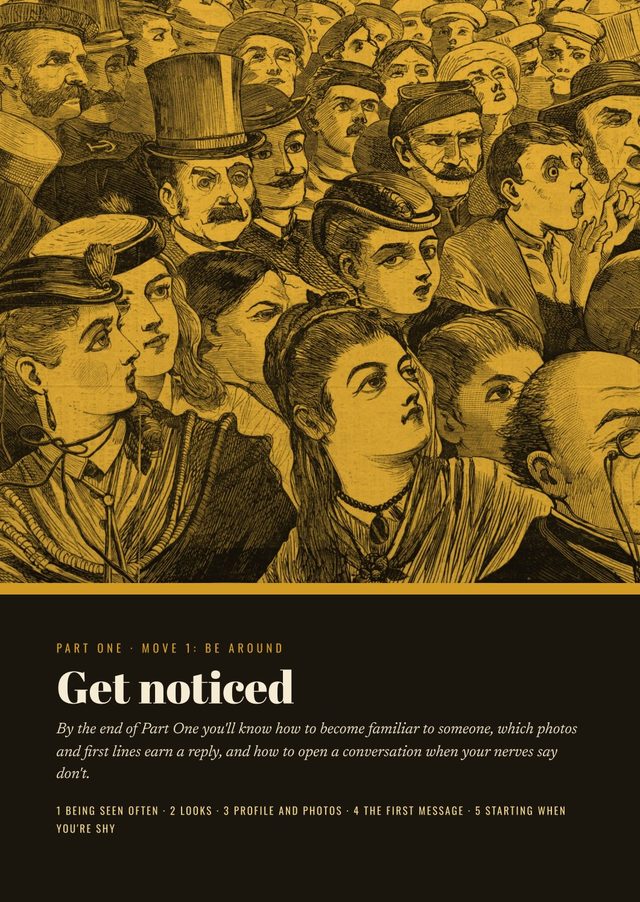
Get noticed
Become familiar to someone without trying too hard, choose photos that work, write a first message that gets a reply, and start talking when you're shy.
Attraction, graded claim by claim
What actually makes someone want you and stay, from the first message to the commitment talk. Built on the attraction research, with every claim graded Solid, Shaky or Made up.
First edition. Sources checked November 4, 2026.
Instant 83-page PDF. Secure Stripe checkout. All sales are final.
You've seen the videos
You've watched the attraction videos. Some of the tips sound clever. A lot of them contradict each other. And almost none of them come with a name and a year you could look up.
The comments say it best. This is FAR too simplistic.
26 min of the same thing.
And from people who've been burned by body language rules: With adhd, it's hard to focus eye contact while talking to someone.
So I went back to the studies. I read 65 papers, reviews and books, and graded 44 of the attraction claims you hear most. Some hold up well. Some came from one small study nobody managed to repeat. Some were never tested at all.
What's left when you clear out the junk is simple, and it points one way:
They choose the person who makes them feel seen.
This book turns that into five moves you can practise, with the words to use from the first message to the "what are we" talk.
Mags Okafor, Second Read
A free lesson from Chapter 4
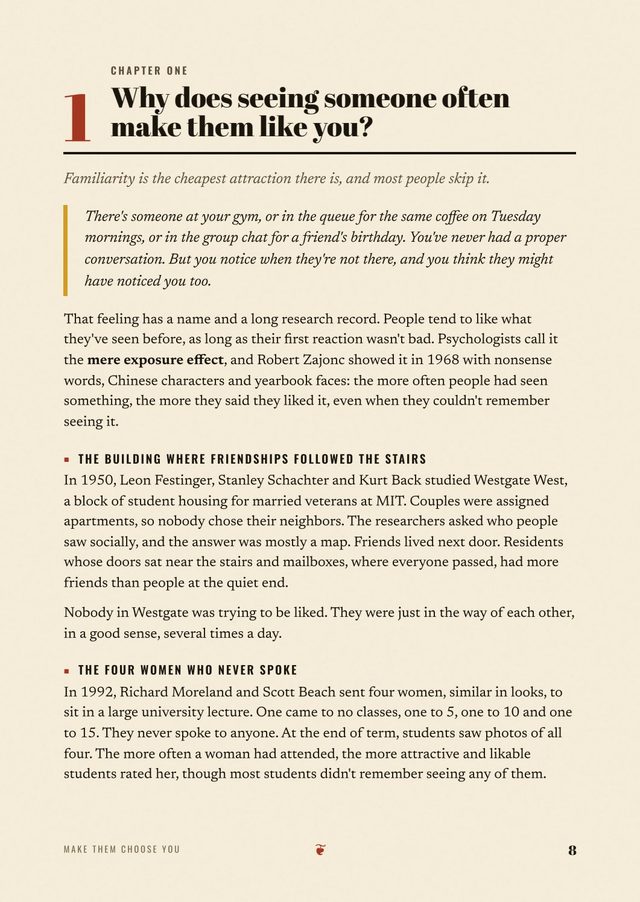
In 2017, Karen Huang and colleagues at Harvard studied question-asking in online chats and at real speed-dating events. People who asked more questions were liked more, and speed daters who asked more got more yeses for a second date.
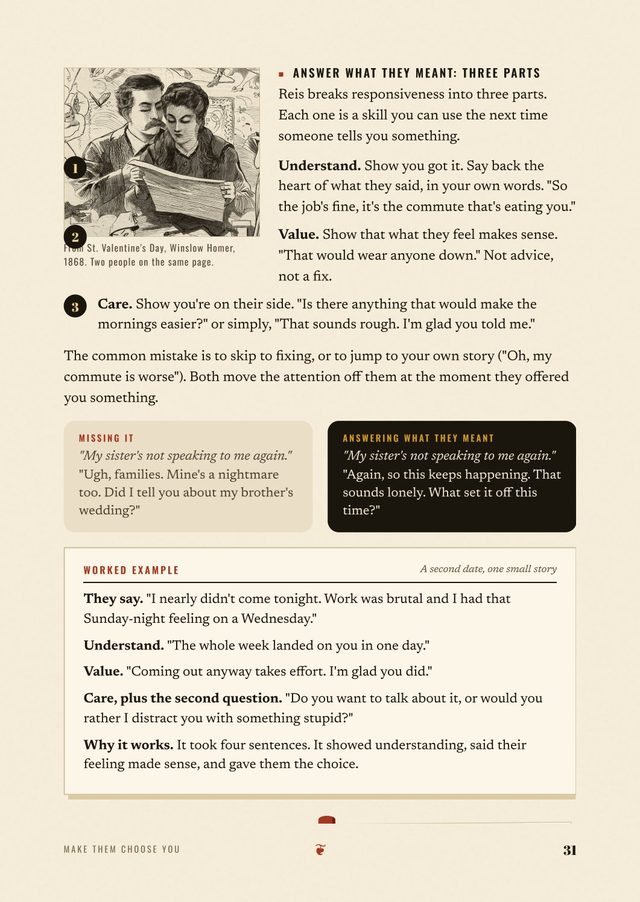
One kind of question did the most work: the follow-up, which picks up something the other person just said. It proves you were listening and that you want more of them. Most people in the studies underestimated how much asking would help, so most people ask too few.
Hey :) how's your week going?
Could be sent to anyone. They know it.
A pottery wheel and a dog in the same photo is a strong opening. What did you make first, and did it survive?
Something specific, and a question they'd enjoy answering.
Shown in lab chats and real speed dates in the same paper, and it fits decades of work on feeling understood.
Huang, Yeomans, Brooks, Minson and Gino (2017), Journal of Personality and Social Psychology.
Try it today: open one chat you left cold and send one line that picks a detail from their profile and asks about it.
What's inside
Become familiar to someone without trying too hard, choose photos that work, write a first message that gets a reply, and start talking when you're shy.
What to talk about on a first date, how to show interest without games, which famous tricks to drop, how to text, and how to tell interest from politeness.
Keep attraction alive, argue without damage, handle pulling away, understand what makes people commit, have the "what are we" talk, and spot love bombing.
Instant 83-page PDF. Secure Stripe checkout. All sales are final.
Look inside
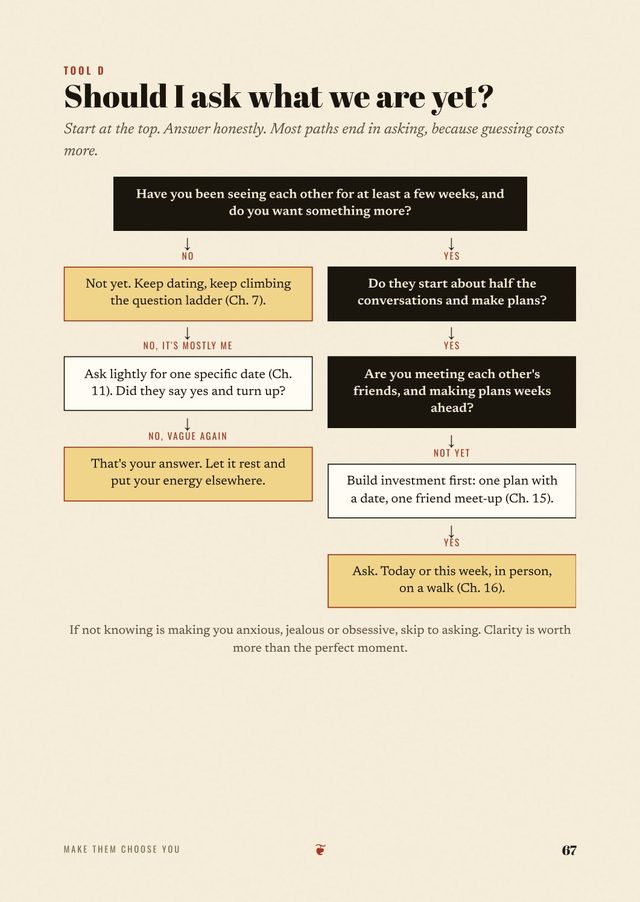
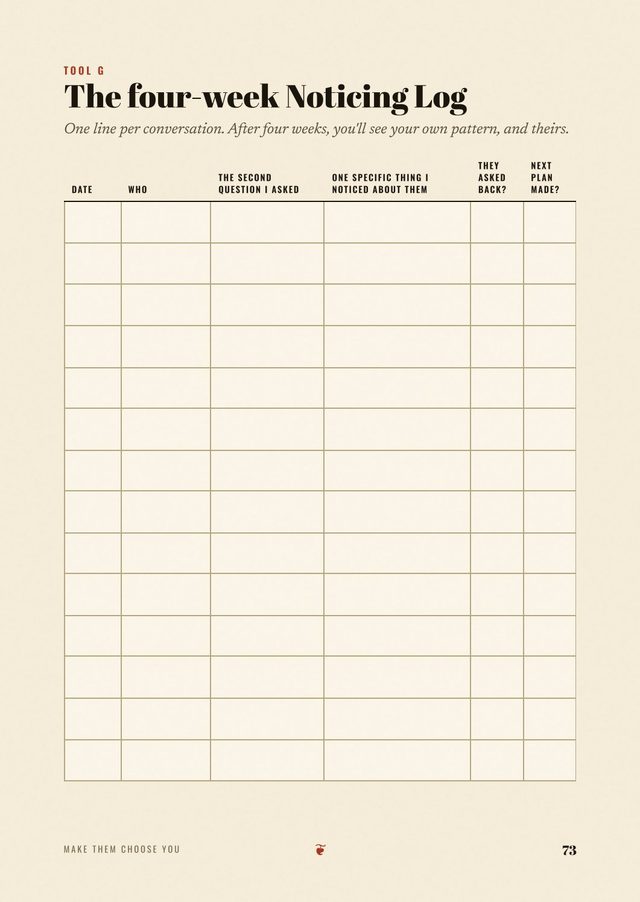
The object
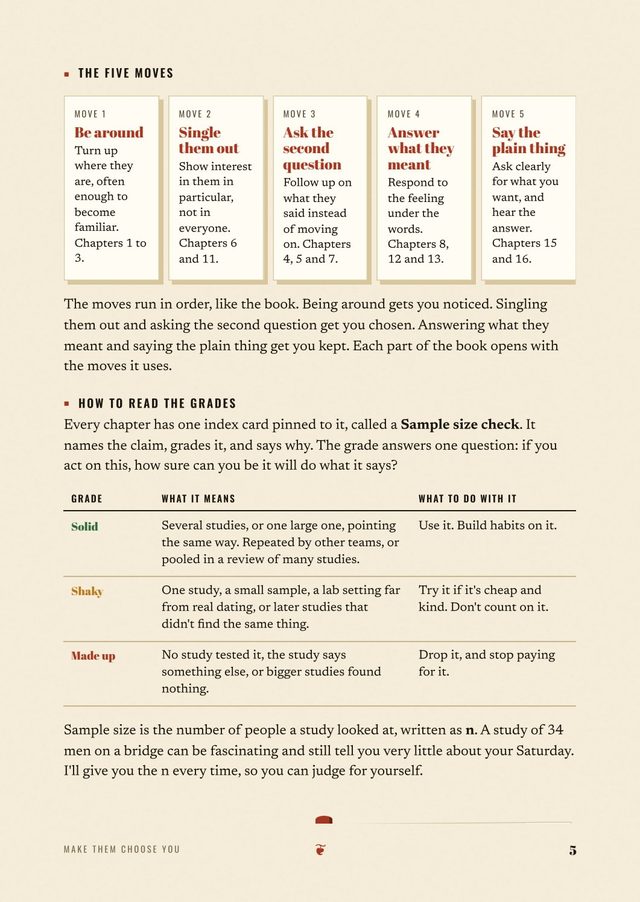
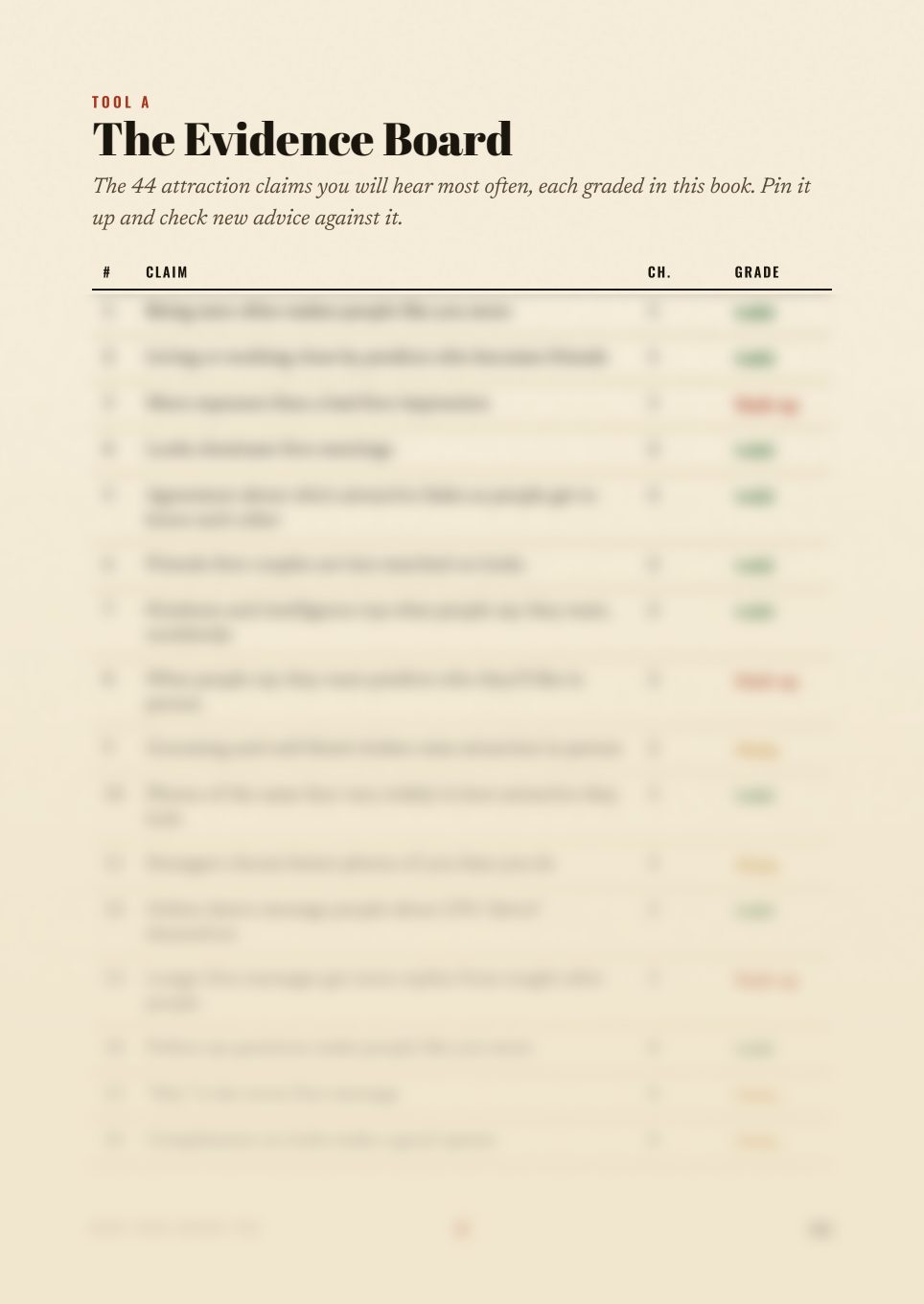
The 44 attraction claims you hear most, on one page you can pin up. The scary bridge, mirroring, the 7-38-55 rule, the 36 questions, the three-day wait. Each one graded, with its chapter.
Which ones landed where is in the book.
Who made this
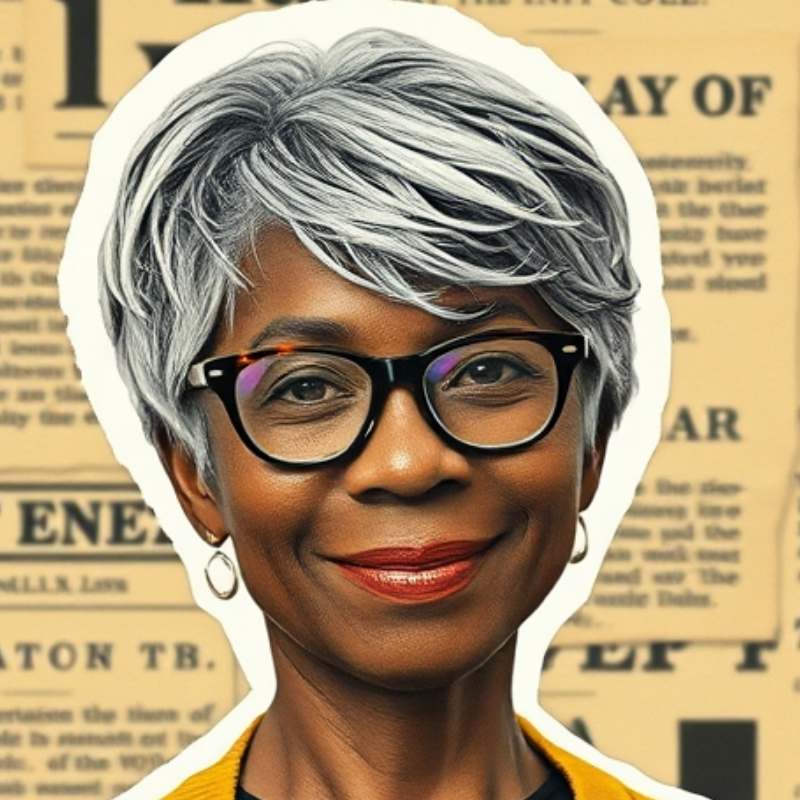
I host Second Read, where every tactic gets an index card and a grade before it reaches you. On the card goes the study, the number of people in it and what it actually measured. Then a grade: Solid, Shaky or Made up.
This book is that corkboard, for attraction. Every claim names its researchers and year so you can look it up. Where a study was small, I say how small. Where a bigger study failed to repeat it, I say that too. Where something is my advice and not a finding, I label it.
Most attraction studies were run on straight couples, often students. The book says so where it matters. The five moves are about how people treat each other, and they work whoever you date.
Questions
No. Chapter 9 checks eight of the famous tricks against their studies, and none of them earns Solid in a real dating setting. The book teaches what does hold up in large studies: familiarity, specific interest, follow-up questions, feeling understood and saying plainly what you want.
It was written with you in mind. Chapter 5 covers the liking gap, the finding that people like you more after a chat than you think, and gives you three ways to start talking and an exit line. Nothing in it asks you to become someone else.
Part Three is for you: keeping attraction alive, arguing without damage, the pull-away loop, what makes people commit, and how to have the "what are we" talk, with a reply for every answer.
Right after checkout you get a download link for the 83-page PDF. It reads well on a phone, a tablet or a laptop, and the tools print fine at home.
All sales are final. This is a digital download you get right away, so we don't offer refunds. This doesn't affect any rights you have by law. That's why the contents, real inside pages and a free lesson are on this page, so you can check before you buy.
17 chapters, 9 tools and 44 claims graded, so you stop spending your evenings on advice that was never tested.
Buy the book for $27Instant 83-page PDF. Secure Stripe checkout. All sales are final.